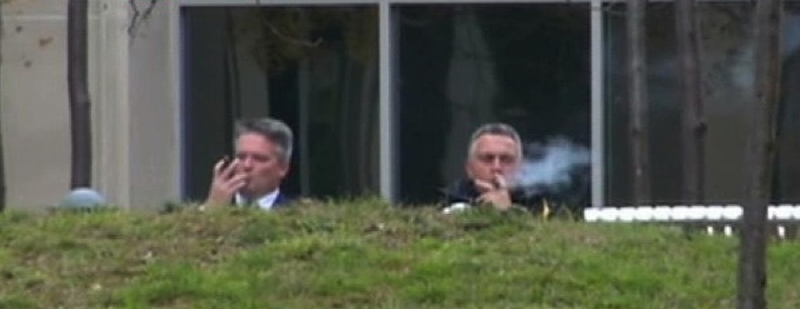
The Australian Treasurer Joe Hockey, right, and the Australian Finance Minister Mathias Cormann share a cigar before they deliver a budget tough on us chronically ill ex-smokers. Priceless!
In the masculine, smoked-filled newsrooms, in which I was a teenage cadet reporter in the 1970s, the Budget headline, year in and year out, was: ‘Beer, Cigs Up’.
When the paper was ‘put to bed’ we’d have a drink and a smoke in the tavern. ‘We should give up, anyway,’ we’d tell ourselves, scowling at our costly 40 cents a pack habit. But we soon cheered up, put a coin in the Wurlitzer and ordered another round, for indeed, ‘Those were the days my friend, we thought they’d never end . . . for we were young, and sure to have our way.’
I feel really old when I remember how once-upon-a-time newspapers were made out of molten metal and our old red-brick Country Press building housed a derelict loft for the pigeons who carried the news. We laughed about it, never dreaming we would one day be as quaint as quills ourselves. Who remembers a linotype clattering away? Soon, who will even remember a newspaper?
One of my jobs as a junior-burger reporter was, on a weekly basis, to take the chain-smoking sportswriter’s hefty olive green Imperial typewriter out the back and, at arm’s length, blast the ash out of the clogged keys with the vacuum cleaner on blow.
From that veteran newshound Stu Wilson, I learned the ropes of reporting and the rules of grammar, such as, a collective noun always takes a singular verb—not anymore it doesn’t, Stu. The Barbarians are at the gate, mate. LOL. I mastered skepticism, shorthand, two-fisted drinking and, importantly, how to two-finger type and smoke at the same time.
Fast forward 40 years and the Australian Treasurer asks us to ‘do the heavy lifting’ as he puts it. Don’t know about you, but I can’t lift more than an eyebrow on a bad air day. Yet is it us, the chronically ill, who have been chosen for a very special mission.
Those of us with Copd—the frequent flyers—with at least a dozen trips to the doctor’s a year, will, from July 1 next year pay more for scripts, tests, x-rays, scans, and for visits to specialists and the GP, in order to contribute money to medical research that might save the lives of future sufferers of Copd—who mostly get sick from smoking cigarettes, which the self-same government licences and taxes in the first place. Hello! Anybody home?
Do we need a fancy $20 billion Medical Research Future Fund to tell us how to cure Copd? We already know how to stop Copd in its tracks. As Leonard Cohen sings, ‘Everybody Knows’.
Our household will manage. There will be economies, but the Black Tuesday budget has me worried about the welfare of a lot of good people I know. And what happens to our community, happens to me.
I live in a region of 25% youth unemployment, with big pockets of working poor and retirees. It is a lovely Kingdom, the Shoalhaven, thickly forested and with idyllic beaches, but at its worst, it can be misery with sea views.
Our kind GP, near to retirement age herself, and often overworked, will hate having to collect the government’s new doctor tax. And if she doesn’t charge a hard-up patient for a visit, she will lose her Medicare consultation fee.
Will the 13th of May 2014 be the date Australia ended the grand social experiment of free universal healthcare? Medicare. It was our boast as we looked with pity at our American cousins whom, we were told, had to sell their homes if they got really sick. We were the lucky country. The land of the fair-go.
I can see with chilling clarity what will happen here, in my neck of the woods, and it’s not going to be the Australia I know and love—a place that was quick to put out its hand to help someone less fortunate.
I’m sad we are asking our kids to pay more for Uni, that’ll stop many going and education is always the way out of poverty.
Lots of kids who can’t get the dole for six months will turn to crime. Suicides will increase. There will be more homeless and more addicts on the streets. This will change the character of our neighbourhoods and justifiably raise people’s fear of being robbed or attacked.
As the squeeze tightens on the families of the working poor, a young mum trying to find the money to visit the doctor and pay for medicines when all the kids are sick at once, mightn’t get around to checking out that lump in her breast. She tells herself she’ll do it next month, when there’s a bit left over. And they might have to let the family pets go, too.
People like us, often middle-aged, who are breathless on the stairs and have a persistent cough might put off asking the doctor about it. ‘It’s probably the cold weather’. ‘I should lose some weight’, ‘I should eat better’, ‘I should exercise more’; all the excuses and rationalisations that stop people like us getting our lungs checked out. Copd or lung cancer, an early diagnosis, education and support gives us the best chance.
Those of us on a disability pension are already stretched. Copd soon erodes savings and, along with our airways, prospects narrow at a time of life we would have expected to still to be earning.
By the time most of us are told we have Copd, we already have severe disease. And over several pulmonary rehabs, I’ve met a lot of sick people who haven’t any money to spare between pension cheques. They will be made anxious by these changes.
As in real-life, it might be more important than ever before for us online communities to be there for each other, as those of us living with lung disease like Copd, and other chronic illnesses, will struggle more when the Black Tuesday budget bites. Having said that, Australia is a good country in which to be ill, when measured against much of the world. And for that I am truly grateful.
All things are possible.
Barbara
To comment, click on the title, and scroll down.
Everybody knows . . .
 The Departure Lounge